

The real estate industry has always relied on relationships, market expertise, and timely decision-making. In 2026, Artificial Intelligence (AI) has become an essential technology that helps real estate businesses work smarter, improve customer experiences, and make better investment decisions.
AI is no longer limited to large enterprises. Today, agencies, brokers, property managers, and real estate developers of every size are using AI-powered solutions to automate repetitive work, analyze market trends, and provide faster services to clients.
Instead of replacing real estate professionals, AI enables them to focus on what matters most—building trust and closing successful deals.
Businesses that embrace AI today are better positioned to improve efficiency, reduce operational costs, and remain competitive in a rapidly changing market.
In this article, Optimity Logics explores ten practical AI applications that every real estate business should know in 2026.
How AI Is Transforming Modern Real Estate
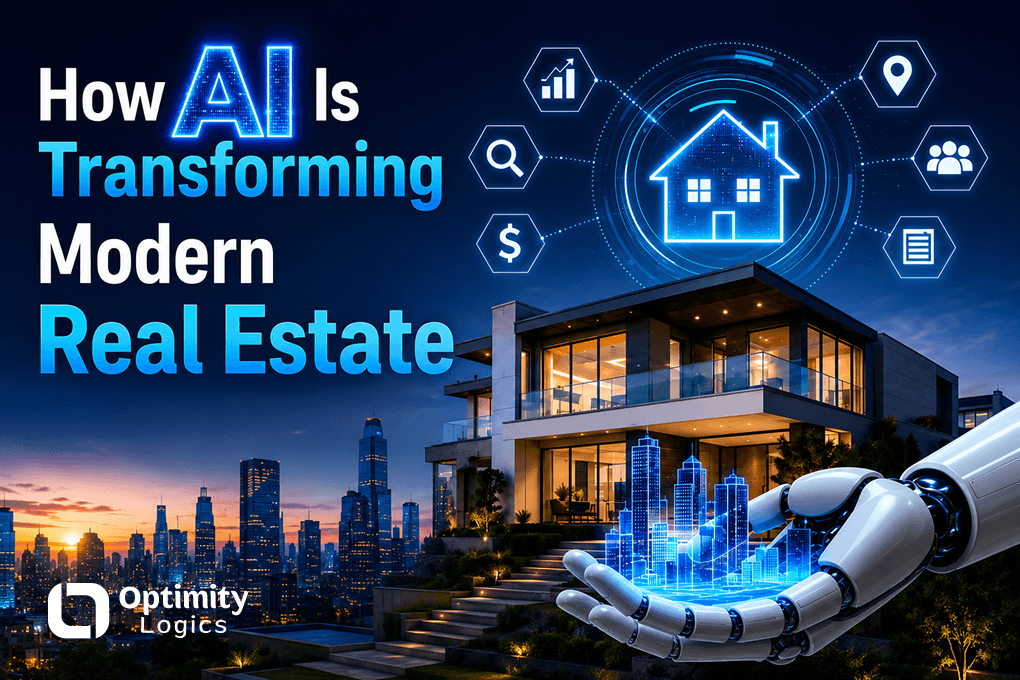
The adoption of AI is changing nearly every stage of the real estate journey. From generating qualified leads to predicting property values, intelligent technologies are helping businesses make informed decisions backed by data rather than assumptions.
AI also enables organizations to deliver personalized customer experiences while automating time-consuming administrative tasks. As a result, teams become more productive, customers receive faster responses, and businesses gain valuable insights that were previously difficult to uncover.
Below are some of the most valuable AI applications transforming the real estate industry.
1. AI-Powered Property Search & Personalized Recommendations
Modern buyers expect personalized property recommendations instead of browsing hundreds of listings manually. AI analyzes a buyer's budget, preferred locations, property type, amenities, search history, and browsing behaviour to recommend the most relevant property listings.
This improves the customer experience, shortens the property search process, and helps real estate agents connect clients with suitable properties more efficiently, ultimately increasing the chances of successful conversions.
2. AI Chatbots & Virtual Real Estate Assistants
Customer expectations have changed, with buyers expecting instant responses at any time of the day. AI-powered chatbots provide 24/7 assistance by answering common questions, sharing property details, scheduling site visits, and collecting lead information.
Virtual AI assistants can also qualify leads, send automated follow-ups, and guide customers through the initial stages of the buying process, allowing sales teams to focus on building stronger relationships and closing deals.
3. Predictive Property Valuation (AI Property Pricing)
Accurate property pricing is essential for successful real estate transactions. AI evaluates historical sales data, nearby property transactions, neighbourhood trends, infrastructure developments, market demand, and property features to estimate competitive property values.
These data-driven insights help buyers, sellers, and investors make informed pricing decisions, reduce valuation errors, and improve negotiation strategies in a competitive market.
4. Predictive Market Analytics & Investment Forecasting
Real estate markets constantly evolve based on economic conditions, buyer demand, and regional development. AI analyzes large volumes of market data to identify trends, forecast property appreciation, estimate rental demand, and highlight emerging investment opportunities.
These insights enable investors and developers to reduce financial risks, make smarter long-term decisions, and identify profitable markets before they become highly competitive.
5. AI Lead Scoring & Buyer Intent Analysis
Not every inquiry represents a serious buyer. AI analyzes customer interactions, website activity, property preferences, email engagement, and browsing patterns to identify leads that are most likely to convert.
By prioritizing high-quality prospects, real estate teams can improve follow-up strategies, increase sales productivity, and achieve better conversion rates while spending less time on unqualified leads.
6. AI-Powered Virtual Tours & Virtual Staging
High-quality property presentations play a major role in influencing buying decisions. AI enhances listing images, improves lighting, removes unwanted objects, and virtually stages empty properties with realistic furniture and décor.
Combined with interactive virtual tours, these technologies allow buyers to explore properties remotely, saving time for both customers and agents while expanding opportunities for international and out-of-town buyers.
7. AI Document Processing & Contract Review
Managing contracts, lease agreements, legal documents, and compliance paperwork is often one of the most time-consuming parts of a real estate transaction. AI automatically extracts important information, verifies document accuracy, identifies missing details, and organizes files efficiently.
This reduces manual effort, minimizes human errors, speeds up transaction processing, and improves overall document management across the business.
8. AI Property Management & Predictive Maintenance
Property managers are responsible for maintenance requests, tenant communication, inspections, rent collection, and operational planning. AI automates many of these routine tasks, helping teams manage multiple properties more efficiently.
AI also analyzes maintenance history and equipment performance to predict potential failures before they occur, reducing repair costs, minimizing downtime, and improving tenant satisfaction.
9. AI Marketing Automation & Content Generation
Creating consistent marketing content across multiple channels can be both time-consuming and resource-intensive. AI helps generate property descriptions, social media posts, email campaigns, digital advertisements, listing summaries, and promotional content within minutes.
It can also analyze campaign performance and customer engagement to optimize marketing strategies, helping real estate businesses reach the right audience while improving return on investment.
10. AI Image Recognition & Property Analysis
Property images contain valuable information that can support faster and more accurate decision-making. AI-powered computer vision analyzes listing photos, drone footage, floor plans, and inspection images to identify room types, structural features, amenities, and property conditions.
These capabilities help automate listing creation, improve property inspections, support more accurate valuations, and provide buyers with detailed property insights before they schedule a physical visit.
Why AI Matters More Than Ever
As competition continues to grow, real estate businesses need solutions that improve efficiency without compromising customer service. AI helps organizations automate repetitive processes, reduce operational expenses, improve decision-making, and deliver personalized experiences that today's customers expect.
Rather than replacing professionals, AI supports them by providing valuable insights that enhance human expertise. The businesses adopting AI today are likely to become tomorrow's market leaders.
Final Thoughts
Artificial Intelligence is transforming the real estate industry by making operations smarter, faster, and more efficient. From intelligent property recommendations and automated customer support to predictive analytics and investment forecasting, AI is helping businesses unlock new opportunities while improving customer satisfaction.
As technology continues to evolve throughout 2026 and beyond, organizations that invest in AI-driven solutions will be better prepared to adapt to changing market demands and customer expectations.
At Optimity Logics, we help businesses leverage modern technologies to build intelligent, scalable, and future-ready digital solutions. Whether you're looking to automate workflows, improve customer engagement, or develop AI-powered real estate platforms, embracing innovation today can create lasting business success tomorrow.