


Artificial intelligence is changing how software applications are designed and developed. Modern AI systems can do much more than answer questions. They can retrieve information, interact with external tools, remember previous conversations, and complete multi-step tasks.
However, building a reliable AI application requires more than connecting a language model to a well-written prompt. The model also needs accurate information, relevant data, appropriate tools, and clear rules.
This is where context engineering comes into the picture.
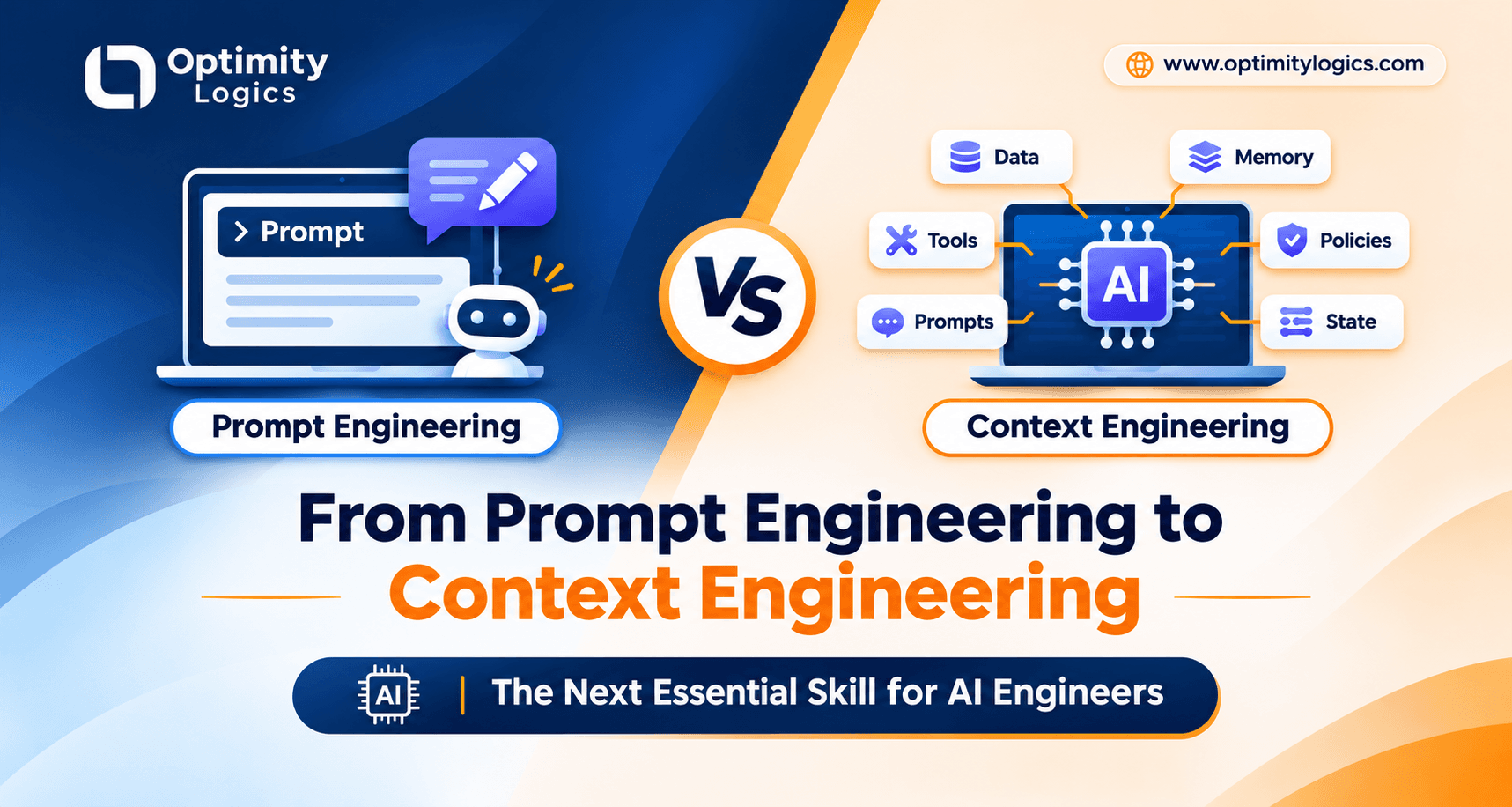
Prompt engineering focuses on how developers communicate instructions to an AI model. Context engineering takes a broader approach by managing the information available to that model. It determines what information the model receives, where it comes from, and how it supports the task.
As AI agents become more capable, this distinction matters more than ever. Developers must learn to design not only effective prompts but also the systems that provide the right context.
What Is Context Engineering?
Context engineering is the process of designing, selecting, and managing the information supplied to an AI model so it can complete a task effectively.
This information is known as context. It can include user instructions, conversation history, business documents, database records, retrieved knowledge, API responses, and workflow state.
A language model uses this information to understand the current situation and generate an appropriate response. Therefore, the relevance and quality of the context can directly influence the usefulness of its output.
Consider an AI customer support assistant handling a refund request. A basic prompt might tell the model to help customers with refunds. However, the model also needs the customer's order details, payment status, refund policy, and previous support interactions.
The application must retrieve this information before the model can make a useful recommendation. As a result, the assistant can respond based on the customer's actual situation rather than general assumptions.
In simple terms, context engineering ensures that an AI model has the information and resources it needs to perform its assigned task.
Prompt Engineering vs Context Engineering
Prompt engineering and context engineering are closely related, but they solve different problems.
Prompt engineering helps developers write clear instructions, define the model's role, provide examples, and specify the expected output. Context engineering manages the wider information environment in which those instructions operate.
For example, an AI invoice processing agent may receive an instruction to extract invoice details and identify potential errors. However, the task also requires vendor records, previous invoices, payment rules, and approval conditions.
The prompt explains what the agent should do. Meanwhile, context engineering provides the information needed to perform that task correctly.
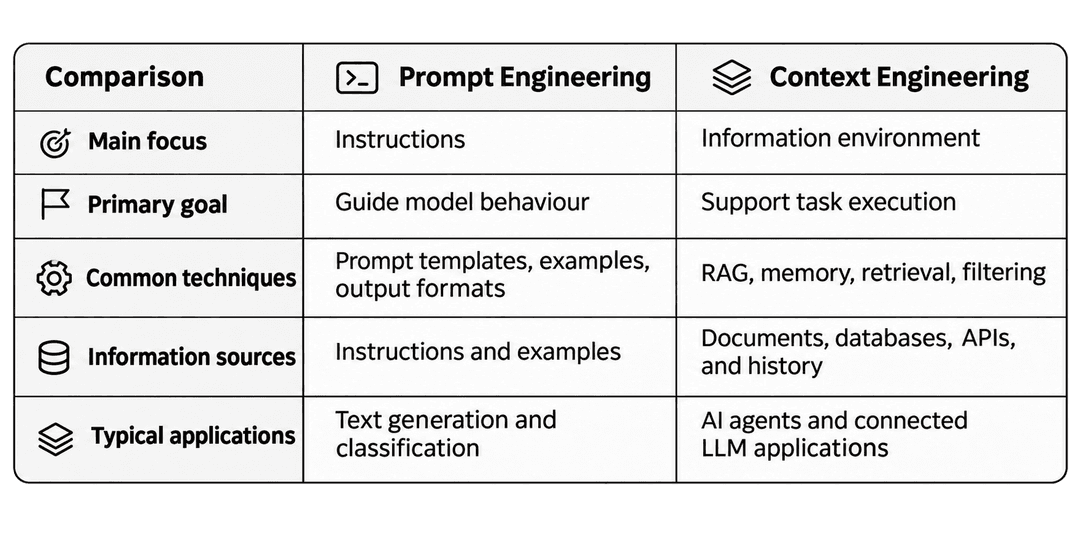
Both approaches are important. However, context engineering becomes particularly valuable when an AI application needs to interact with changing information and external systems.
Why Prompt Engineering Alone Is Not Enough
A well-written prompt can improve an AI response. Nevertheless, it cannot solve every challenge involved in building a production AI application.
AI Models Need Current Information
A language model may understand how order management works, but it cannot automatically know the latest status of a customer's order.
For this reason, applications need connections to databases, APIs, and other information sources. These integrations allow the model to work with current records instead of relying only on previously learned information.
Long Conversations Need Better Management
AI applications often handle conversations that continue across multiple messages and sessions. Sending the complete conversation every time can increase token usage and introduce unnecessary information.
Instead, developers need to identify important details, summarise older interactions, and retain useful information through an appropriate memory system.
Business Rules Require Reliable Validation
Businesses operate with specific policies, permissions, approval limits, and operational requirements.
For example, an invoice above a defined amount may require manager approval. A prompt can explain this condition, but the application should enforce the approval rule through reliable business logic.
AI Agents Need External Tools
Modern AI agents may need to retrieve records, send emails, create tickets, or update business systems.
A prompt can describe when an agent should use a tool. However, developers must also implement the integration, validate inputs, manage permissions, and process the returned results.
More Context Does Not Always Mean Better Results
Adding every available document and database record to a model request can make the context less useful.
Irrelevant information competes with important details. Consequently, the model may overlook information that directly affects its response.
Effective context engineering focuses on selecting the right information rather than simply providing more information.
Five Core Components of Context Engineering
Context engineering combines several techniques to help AI models work with useful and reliable information. Although each application has different requirements, five components are particularly important.
1. Data Retrieval and Retrieval-Augmented Generation
Retrieval-Augmented Generation, commonly called RAG, connects an AI model to external knowledge sources.
Instead of relying entirely on information learned during training, an application retrieves relevant content from documents, databases, or knowledge bases. It then supplies the selected information as part of the model's context.
A typical RAG system collects documents, divides them into smaller sections, and generates embeddings. These embeddings are stored in a vector database. When a user submits a query, the application searches for relevant information and adds the retrieved results to the model's input.
For example, an internal HR assistant could retrieve the latest company leave policy before answering an employee's question. Similarly, a technical support assistant could search product documentation before suggesting a solution.
However, RAG quality depends on more than connecting a vector database to an LLM. Document quality, chunking strategy, metadata, retrieval filters, and ranking also influence the results.
Therefore, developers should evaluate the complete retrieval process instead of focusing only on the technology used to store embeddings.
2. Memory and Conversation History
Memory allows an AI application to retain useful information across interactions. It helps the system maintain continuity instead of treating every request as a completely new conversation.
For example, a customer support agent may need to remember an unresolved complaint, previous troubleshooting steps, and the current ticket status. When the customer returns, the application can retrieve those details and continue the interaction.
However, memory does not mean storing every conversation permanently. Developers must decide which information is valuable, when it should be updated, and how long it should remain available.
Some applications use short-term memory for recent messages and active tasks. Others maintain longer-term information through databases or structured storage. In addition, task-specific memory can preserve completed actions and pending decisions.
The most important consideration is accuracy. Outdated memory can create the same problems as outdated documents.
3. Tool and API Integration
An AI agent becomes more useful when it can interact with external systems.
Tool integration connects a model with databases, CRM platforms, email services, payment systems, and internal APIs. As a result, an agent can access information and perform actions beyond generating text.
For instance, an AI sales assistant could retrieve a customer record, check product availability, calculate a quotation, and prepare a follow-up email.
However, these actions require careful engineering. Developers must validate inputs, manage permissions, handle API failures, and verify the results returned by external services.
Furthermore, sensitive operations should not depend entirely on a model's decision. The application should control which actions are permitted and when additional approval is required.
4. Context Filtering and Prioritisation
An AI application may have access to thousands of documents and records. However, only a small portion may be relevant to the current request.
Context filtering identifies the information that actually supports the task. Developers can use metadata, relevance scoring, date filters, access permissions, and document ranking to select appropriate results.
Imagine a support agent answering a question about one delivery. It does not need the customer's complete purchase history. Instead, it needs the relevant order details, delivery status, and applicable policy.
By removing duplicate, outdated, and unrelated information, developers can create a more focused context. This also helps manage token usage and reduces unnecessary processing.
5. Business Rules, Permissions, and Workflow State
A production AI application needs clear operational boundaries. Business rules define what the system can do, permissions control access, and workflow state records what has already happened.
Consider an invoice processing agent. It may need to verify invoice details, check whether the vendor exists, identify duplicate invoices, and determine whether the amount requires manager approval.
These checks should not depend entirely on the model's interpretation. Critical business conditions should be enforced through application logic.
The AI model can extract information, identify potential issues, and recommend the next action. Meanwhile, the application validates conditions, controls permissions, and manages the approval process.
This separation is especially important when AI systems interact with financial, customer, or operational data.
How Context Engineering Works in an AI Agent
Context engineering is not a single prompt or database. Instead, it connects information sources, retrieval systems, application logic, and model interactions.
A typical AI agent starts by receiving a user request or an event from an external system. The application then identifies the task and determines what information is necessary.
Next, it retrieves relevant records, documents, and conversation history. At the same time, it checks access permissions and applies the business rules required for the task.
Once the necessary information is available, the application prepares the model context. This may include instructions, retrieved knowledge, tool definitions, relevant conversation history, and the current workflow state.
The model then analyses the information and generates a response or selects an available tool. If the agent requests an external action, the application executes it according to the configured permissions.
Finally, the system validates the result, updates the workflow, and stores information needed for future interactions. If the task involves an uncertain or sensitive decision, the application can request human approval.
This approach makes context management part of the complete AI application rather than an isolated prompt-writing exercise.
Practical Example: An AI IT Incident Triage Agent
Consider an IT support team that receives incident reports from employees. A basic chatbot might collect the issue description and suggest general troubleshooting steps.
However, an operational incident triage agent needs more information to provide useful recommendations.
It may need the employee's incident description, device information, previous support tickets, internal troubleshooting documentation, and escalation policies.
When an employee reports an issue, the workflow first collects the incident details. The application then retrieves relevant knowledge base articles and previous incident records.
Next, the AI model analyses the supplied information and suggests an incident category, priority, and possible troubleshooting steps. The application checks the result against defined escalation rules.
If the incident meets the escalation conditions, the workflow creates or updates a support ticket and notifies the appropriate team. Otherwise, it can provide recommended next steps to the employee.
The important point is that the agent does not make its decision from the initial message alone. It works with relevant context while application logic controls the operational process.
This is where context engineering creates practical value. It connects AI reasoning with the information and systems required to complete a real business task.
Best Practices for Building Context-Aware AI Applications
Building a context-aware application requires careful planning. Developers should understand the task first and then design the information flow around its requirements.
Start by defining exactly what the AI system needs to accomplish. A document classification agent, for example, may require document content, classification rules, and confidence thresholds. It probably does not need an entire customer conversation history.
Once the requirements are clear, select the information sources that support the task. Use targeted retrieval instead of sending every available record to the model. Metadata filters, relevance scoring, and permission checks can help keep the context focused.
It is equally important to separate model instructions from critical business logic. Prompts should explain the model's role and expected output. However, financial limits, access permissions, and other important conditions should be enforced by the application.
Developers should also validate external data before using it. Retrieved documents may be outdated, database records may contain missing fields, and APIs may return unexpected responses. Validation helps prevent unreliable information from moving through the workflow.
Finally, include human approval wherever an operation requires additional oversight. Sensitive financial actions, account changes, and high-impact decisions may need explicit authorization before execution.
These practices help make AI systems more predictable, maintainable, and suitable for real-world use.
How to Measure Context Engineering Quality
A context-engineered application should be evaluated through its actual performance, not just the quality of its prompts.
One important measurement is retrieval relevance. Developers need to know whether the system retrieves information that genuinely supports the user's request. They should also evaluate answer accuracy and groundedness to determine whether generated responses match the supplied evidence.
Tool execution is another important area. An agent may produce a correct explanation but fail when an external API returns an error. Therefore, developers should measure tool success rates and workflow completion rates alongside response quality.
Context efficiency matters as well. Applications should use relevant information without unnecessarily increasing token usage, latency, or cost.
For sensitive applications, escalation accuracy is particularly important. The system should recognise situations that require human intervention instead of attempting to complete every task automatically.
Together, these measurements provide a more complete view of an AI application's reliability.
Common Context Engineering Mistakes to Avoid
Even a well-designed AI architecture can produce unreliable results when developers overlook context quality.
One common mistake is sending too much information to the model. A large context does not automatically improve an answer. Instead, irrelevant details can make important information harder to identify.
Another issue is relying on outdated documents or stored information. If the application retrieves an old policy or incorrect customer record, the model may generate a response that appears reasonable but does not reflect the current situation.
Developers should also avoid giving unrestricted access to external tools. AI agents need clearly defined permissions, validated inputs, and appropriate controls around sensitive operations.
Finally, skipping realistic testing can hide important problems. Applications should be tested with missing data, unexpected API responses, conflicting information, and situations that require human approval.
Ultimately, the goal is not simply to make an AI model generate better responses. It is to build an application that uses information responsibly throughout the complete workflow.
Is Context Engineering Replacing Prompt Engineering?
No. Context engineering does not replace prompt engineering. Instead, it expands the way developers approach AI application design.
Prompt engineering remains important because language models need clear instructions, task definitions, and expected output formats. Without those instructions, even relevant information may not produce the intended result.
However, instructions alone cannot provide access to current business records, external services, or previous workflow states.
For example, a prompt can tell an AI agent to summarise a customer's support history. Context engineering determines which conversations to retrieve, how to organise the information, and which details the model is allowed to access.
Both disciplines therefore play different but complementary roles.
As AI applications become more connected, developers will need to understand prompt design alongside retrieval, memory, API integration, data management, and workflow orchestration.
How Developers Can Start Learning Context Engineering
Developers who already understand APIs, databases, and AI models have a useful foundation for learning context engineering.
A practical approach is to start with large language model fundamentals. Understand tokens, context windows, model inputs, and output generation. Then improve prompt engineering skills by practising clear instructions and structured response formats.
The next step is learning retrieval and RAG. Explore embeddings, document chunking, vector databases, metadata filtering, and retrieval evaluation. These concepts explain how an AI application can access information beyond its initial prompt.
After that, experiment with API integrations and memory systems. Connect a model to a database or external service, preserve relevant conversation details, and manage task progress.
Finally, build an end-to-end AI workflow. It should retrieve information, apply business rules, interact with external tools, and handle exceptions. Test the application with realistic scenarios, including missing information and failed API calls.
Tools such as LangChain, LlamaIndex, vector databases, and workflow automation platforms can help developers explore these concepts. Nevertheless, learning every tool is not the objective. Understanding how information moves through an AI application is far more important.
The Future of AI Engineering Goes Beyond Better Prompts
AI development is moving from isolated model interactions towards connected systems that work with business data, external services, and multi-step workflows.
As this shift continues, developers will need to think beyond the prompt itself. They must understand where information comes from, how it is selected, when it becomes outdated, and which actions an AI system can safely perform.
Context engineering brings these responsibilities together. It helps developers design applications that use relevant information, maintain useful state, interact with external tools, and follow defined business rules.
The next generation of AI engineers will not just know how to ask a model the right question. They will know how to provide the right information, tools, and boundaries to complete the task.
At Optimity Logics, we believe practical AI engineering requires more than connecting a model to an application. It requires thoughtful data integration, workflow design, and reliable automation.
Explore how better context design can support your next AI agent or business automation project.


