


Introduction: Is Your Website Ready for the Future of Search?
Imagine a potential customer asking ChatGPT to recommend the best AI development company for their business. Your competitors appear in the response, while your website remains completely invisible. Despite offering excellent services, you miss an opportunity to connect with customers.
This situation highlights an important change in how people discover businesses online. Search engines are no longer the only destinations where customers look for information. Instead, AI-powered platforms such as ChatGPT, Gemini, and Perplexity are changing how users research products, compare services, and make purchasing decisions.
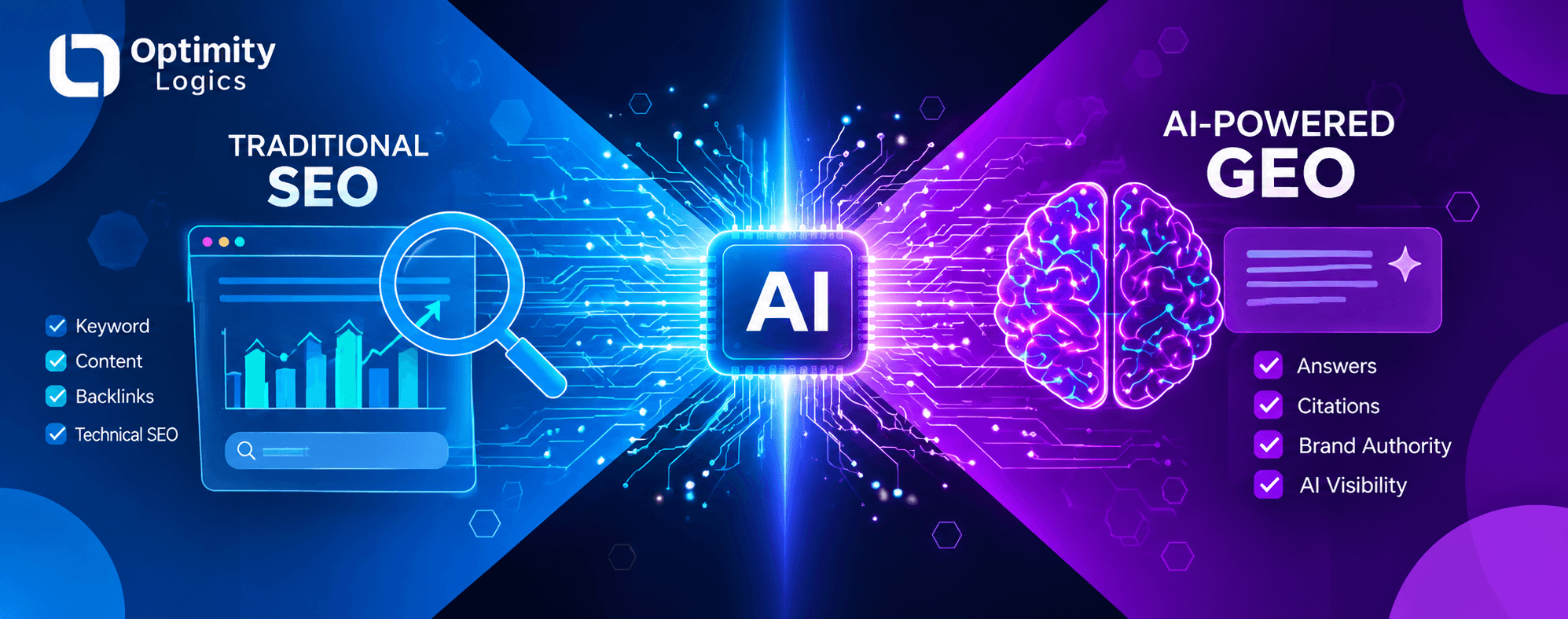
This shift introduces a new digital marketing strategy called Generative Engine Optimization (GEO). While traditional Search Engine Optimization (SEO) focuses on improving website rankings, GEO helps businesses make their information more understandable and discoverable across AI-powered search experiences.
However, does this mean traditional SEO is becoming less important? Not necessarily. Both strategies serve different purposes, and combining them can help businesses build stronger digital visibility. In this guide, we will explore GEO vs SEO, understand their differences, and discover practical ways to optimize your website for AI search in 2026.
1. What Is SEO (Search Engine Optimization)?
Search Engine Optimization (SEO) is the process of improving a website's visibility in search engines such as Google and Bing. It involves optimizing website content, technical performance, keywords, and backlinks to help search engines understand and display relevant pages.
For example, imagine a business offering AI automation services. When potential customers search for "AI automation services for small businesses," an effective SEO strategy can help relevant service pages appear in organic search results.
Traditional SEO focuses on several important areas:
- Keyword Research: Identifying relevant search terms that potential customers use when looking for products or services.
- On-Page SEO: Optimizing page titles, headings, URLs, meta descriptions, and website content.
- Technical SEO: Improving website speed, mobile responsiveness, crawlability, and indexing.
- Off-Page SEO: Building website authority through relevant backlinks, brand mentions, and industry relationships.
- Content Optimization: Publishing informative blogs, guides, and resources that answer users' questions.
The primary objective of SEO is to make websites easier to discover while delivering valuable information. Consequently, businesses can attract relevant visitors, generate organic traffic, and improve their opportunities for customer conversions.
2. What Is GEO (Generative Engine Optimization)?
Generative Engine Optimization (GEO) is the practice of improving website content and brand information so AI-powered platforms can discover, understand, and potentially reference them in generated responses.
Unlike traditional search engines, generative search experiences can combine information from multiple sources into conversational answers. For example, someone might ask ChatGPT, "Which company provides reliable AI automation services for growing businesses?"
An AI platform may identify relevant information, summarize available sources, and provide references to websites that support its response. GEO focuses on making your website a useful source for these discovery experiences.
Businesses can strengthen their GEO strategy through several practices:
- Answer-Focused Content: Providing direct, informative answers to common customer questions.
- Topical Authority: Covering related subjects with sufficient depth and relevant industry knowledge.
- Reliable Information: Supporting important statements with accurate facts, research, and trustworthy references.
- Clear Content Structure: Using descriptive headings, meaningful paragraphs, and practical examples.
- Brand Authority: Maintaining consistent business information and building credibility across relevant platforms.
Importantly, GEO does not guarantee that an AI platform will mention your business. Instead, it improves the quality, clarity, and discoverability of information that AI systems may use.
3. GEO vs SEO: Understanding the Key Differences
Although GEO and SEO share several optimization principles, their primary objectives differ. SEO focuses on improving visibility within traditional search results, whereas GEO targets discoverability and potential references within AI-generated responses.
Understanding these differences helps businesses develop a balanced digital marketing strategy.
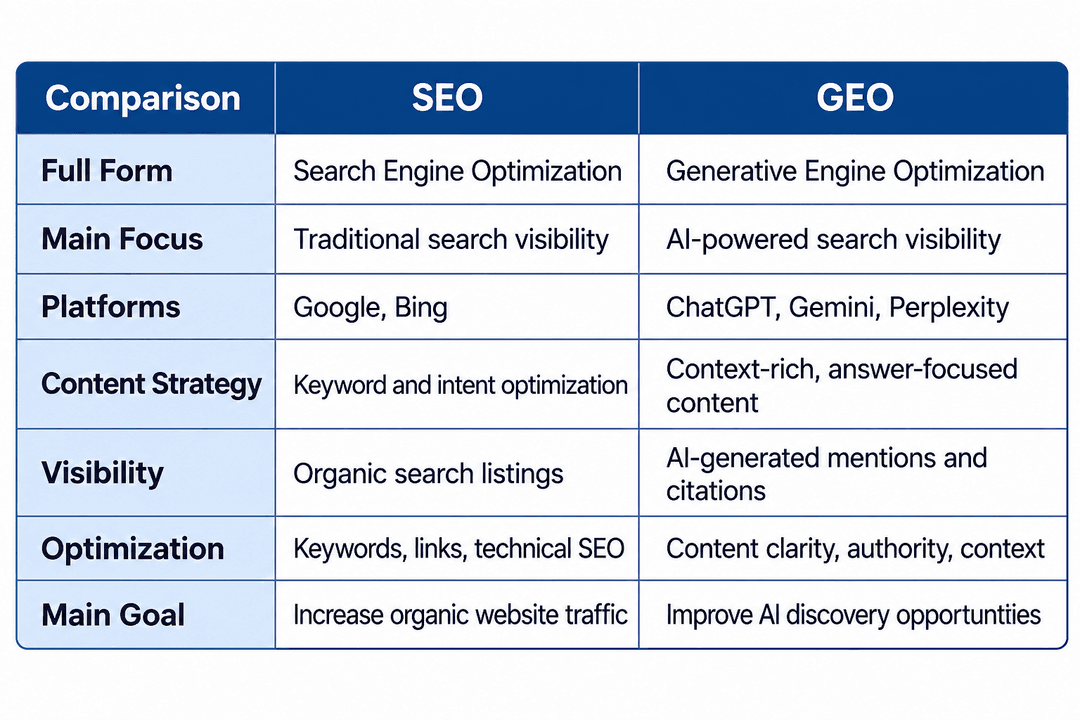
For example, an SEO-focused article might target the keyword "AI chatbot development company." Meanwhile, a GEO-focused article could answer a detailed question about choosing an AI chatbot development partner.
Both approaches can support the same customer journey. Therefore, businesses should avoid treating GEO and SEO as competing strategies.
4. Why Is GEO Important for Businesses in 2026?
Customer search behavior continues to evolve as AI-powered platforms become useful tools for researching information and comparing business solutions. Consequently, companies need to consider additional ways to make their services discoverable online.
Here are four important reasons businesses should pay attention to GEO.
Changing Customer Search Behavior
People increasingly use conversational questions instead of searching only with short keywords. For instance, someone might ask an AI assistant how to automate customer support without increasing operational costs.
This creates opportunities for businesses to publish content that addresses specific customer problems. Moreover, informative articles can explain complex services in a more accessible way.
Increased Brand Discovery Opportunities
Traditional search rankings remain valuable, but they represent only one part of online discovery. AI-generated responses create additional opportunities for businesses to become visible while customers research relevant products and services.
For example, a company specializing in Shopify development could publish useful guides about ecommerce optimization, custom themes, and conversion improvements. These resources can help establish its expertise across multiple discovery channels.
Building Trust Through Helpful Information
Customers rarely choose a service provider without researching available options. They compare expertise, understand solutions, and evaluate whether a company can address their specific requirements.
Therefore, publishing accurate explanations, detailed case studies, and practical industry insights can strengthen brand credibility. Helpful content also gives potential customers more reasons to explore your services.
Preparing for Future Search Experiences
AI-powered search continues to develop, creating new opportunities and challenges for digital marketing teams. Businesses that invest in content quality, website accessibility, and consistent brand information can establish stronger foundations for future discovery.
However, GEO should complement established SEO practices rather than replace them.
5. How to Optimize Your Website for AI Search in 2026
Understanding GEO is useful, but implementing the right strategies creates meaningful opportunities for improvement. Businesses should focus on publishing valuable information, improving technical accessibility, and demonstrating genuine industry expertise.
Consider these six practical strategies when preparing your website for AI-powered search.
1. Create Helpful, Answer-Focused Content
Start by identifying the questions your potential customers frequently ask about your products and services. Then, create detailed articles that answer those questions with clear explanations and relevant examples.
For an AI development company, useful topics might include:
- How does AI automation improve business operations?
- What is the difference between AI agents and chatbots?
- How much does custom AI development cost?
- Which business processes can AI automate?
- How can companies implement AI-powered customer support?
Begin each section with a direct answer before explaining the topic in greater detail. Additionally, include practical examples that help readers understand how different solutions work.
Avoid creating articles that repeat keywords without providing meaningful information. Instead, prioritize accuracy, originality, and content that genuinely solves customer problems.
2. Organize Content With Clear Headings
Well-organized content improves readability and helps readers understand complicated subjects more easily. Similarly, descriptive headings provide useful context about the information covered within individual sections.
Use one primary H1 heading for your article and organize major topics using H2 headings. Furthermore, add H3 headings when a section requires additional explanations or supporting examples.
Keep paragraphs focused on individual ideas rather than combining unrelated information. You can also include comparison tables, bullet points, and numbered instructions wherever they improve understanding.
For example, a heading such as "How AI Automation Reduces Operational Costs" communicates more information than a generic heading such as "Benefits." This makes your content easier to navigate and understand.
3. Build Topical Authority With Related Articles
Publishing one article about artificial intelligence does not automatically establish your website as an industry authority. Instead, develop a consistent content strategy covering multiple subjects related to your business expertise.
For example, an AI automation company could create a content cluster around AI agents, business workflows, and intelligent customer support.
Supporting articles might include:
- AI Workflow Automation for Small Businesses
- AI Agents vs Traditional Automation
- How to Build an AI Customer Support Agent
- n8n Automation for Business Processes
- RAG-Based Chatbots for Enterprise Knowledge
- AI-Powered Lead Management Systems
Connect these articles through relevant internal links and direct readers toward useful service pages. Consequently, visitors can explore related information while understanding the solutions your company provides.
4. Demonstrate Real Experience and Expertise
Generic content is widely available online, making original experience an important way to differentiate your website. Readers want practical information that helps them understand how technologies work in real business environments.
Include genuine project examples, implementation challenges, technology choices, and verified outcomes wherever possible. For instance, an AI hotel concierge case study could explain how automated assistants answer guest questions and notify hotel staff about service requests.
Additionally, include screenshots, workflow diagrams, technical explanations, and development insights from completed projects. These elements provide useful context while demonstrating your team's capabilities.
Remember that credibility comes from accurate information and genuine experience rather than exaggerated claims. Therefore, review every technical explanation and verify statistics before publishing.
5. Improve Technical SEO and Website Accessibility
High-quality content needs a technically accessible website to perform effectively. Search engines must discover and process important pages before they can display them in relevant search experiences.
Start by reviewing your website's technical performance and addressing issues that affect crawling, indexing, and usability.
Important technical improvements include:
- Maintain an updated XML sitemap.
- Ensure important pages remain crawlable and indexable.
- Optimize loading speed and Core Web Vitals.
- Improve mobile responsiveness and navigation.
- Use descriptive URLs and relevant page titles.
- Implement HTTPS across your website.
- Fix broken internal links and indexing errors.
- Make important content accessible as readable text.
Additionally, check how search engines process JavaScript-rendered content. Proper rendering and accessible page content help establish a stronger technical foundation for organic search visibility.
6. Use Structured Data and Monitor AI Visibility
Structured data provides additional context about your website's content and helps search engines interpret important information. Relevant Schema.org markup can describe organizations, articles, services, products, and breadcrumb navigation.
However, structured data does not guarantee AI citations or improved rankings. Always ensure your markup accurately reflects information visitors can see on the corresponding pages.
Once your technical improvements are complete, monitor how your website performs across different discovery platforms. Test relevant customer questions on ChatGPT, Gemini, and Perplexity to understand whether your brand appears in useful responses.
Track brand mentions, website citations, organic impressions, referral traffic, and conversions. Furthermore, use Google Search Console and Bing Webmaster Tools to evaluate available search performance information.
AI responses can change between searches, so measure visibility across multiple questions and time periods. This provides a more realistic understanding of your website's progress.
6. Common GEO Mistakes Businesses Should Avoid
While GEO creates new opportunities, businesses should avoid optimization shortcuts that reduce content quality. A successful strategy requires consistent effort, accurate information, and a genuine focus on customer needs.
Here are four common mistakes worth avoiding:
Publishing Unreviewed AI Content: AI writing tools can accelerate content creation, but unverified information may introduce inaccurate claims. Always review generated content, add original insights, and verify important technical details.
Ignoring Traditional SEO: GEO does not eliminate the importance of keyword research, website accessibility, backlinks, or technical optimization. Businesses should maintain their existing SEO foundations while exploring AI search opportunities.
Overusing Keywords: Repeating keywords unnaturally can make articles difficult to read and reduce their usefulness. Instead, use relevant phrases naturally while focusing on the actual questions customers want answered.
Expecting Guaranteed AI Mentions: No legitimate optimization strategy guarantees inclusion in ChatGPT, Gemini, or other AI-generated responses. Focus on improving your content and brand credibility while monitoring measurable results.
7. The Future of Search: Why Businesses Need Both GEO and SEO
The future of digital discovery will involve multiple ways for customers to find information and evaluate business solutions. Traditional search engines will remain important, while AI-powered experiences continue developing new approaches to information discovery.
For businesses, this means visibility should not depend entirely on one platform or traffic source. Instead, a balanced strategy should combine technical SEO, valuable content, relevant brand mentions, and AI-friendly information.
Consider a company offering custom AI development services. Its SEO strategy can target relevant commercial keywords, while its GEO strategy can address detailed questions about AI implementation, development costs, and business automation.
Moreover, these approaches can support customers throughout their decision-making journey. Someone researching AI technology might discover an educational article before eventually visiting a company's service page.
The most effective strategy is therefore to create useful information that performs well in traditional search while remaining understandable and relevant across AI-powered discovery experiences.
8. How Optimity Logics Helps Businesses Prepare for AI-Driven Growth
Building a strong digital presence requires more than publishing articles or targeting popular keywords. Businesses also need reliable technology solutions that support customer experiences, improve operational efficiency, and encourage long-term growth.
At Optimity Logics, we help businesses explore modern digital solutions through AI development, automation, full-stack development, and Shopify services.
Our capabilities include:
- AI Development: Creating custom AI-powered applications and intelligent business solutions.
- AI Automation: Automating repetitive business processes through connected workflows and intelligent integrations.
- AI Agent Development: Building AI agents that support customer interactions and business operations.
- Full Stack Development: Developing responsive, scalable, and high-performance web applications.
- Shopify Development: Building customized ecommerce experiences that support growing businesses.
Whether you want to develop an intelligent application, automate business operations, or create a modern ecommerce platform, our team can help transform your ideas into practical technology solutions.
Ready to explore what's possible with modern technology?
Visit https://optimitylogics.com/ and connect with Optimity Logics to discuss your next digital project.
9. Frequently Asked Questions About GEO and SEO
What is the main difference between GEO and SEO?
SEO improves website visibility in traditional search engine results, while GEO focuses on making content discoverable and potentially referenceable within AI-generated responses. Both strategies help businesses improve their online presence through different discovery experiences.
Does GEO replace SEO in 2026?
No, GEO complements traditional SEO rather than replacing it. Search engines and AI-powered platforms still benefit from accessible, relevant, and useful website information. Therefore, businesses should maintain strong SEO foundations while improving content for AI discovery.
How can I optimize my website for ChatGPT and Gemini?
Publish accurate information, organize content with descriptive headings, explain your services clearly, and build genuine brand authority. Additionally, maintain technical accessibility and answer relevant customer questions throughout your website.
Is GEO important for small businesses?
Yes, GEO can help small businesses improve discoverability around specialized services and industry-specific questions. Publishing informative resources, demonstrating genuine expertise, and maintaining consistent business information can support long-term digital visibility.
Does structured data improve AI search visibility?
Structured data helps search engines understand information about your website, organization, and published content. However, it does not guarantee AI-generated mentions or citations. Use accurate markup alongside strong technical SEO and helpful content.
How long does GEO take to show results?
There is no guaranteed timeline because AI visibility depends on several factors, including content relevance, website accessibility, brand authority, and platform-specific retrieval systems. Businesses should monitor their progress consistently and improve their strategies using available performance data.
Which platforms should businesses consider for GEO?
Businesses can monitor their presence across ChatGPT, Google AI Overviews, Google AI Mode, Gemini, and Perplexity. Since these platforms may retrieve different information, maintaining a consistent and trustworthy online presence is important.
Conclusion: Build Your Digital Visibility for the AI Search Era
The way customers discover businesses is changing, creating new opportunities for companies that adapt their digital strategies. Traditional search rankings remain valuable, but AI-powered discovery is introducing additional ways for people to find information and evaluate services.
SEO helps your website become easier to discover through search engines. Meanwhile, GEO focuses on making your information useful, understandable, and potentially referenceable in AI-generated responses.
Businesses should combine both approaches instead of choosing one over the other. Focus on valuable content, technical accessibility, original expertise, and consistent brand authority to build a stronger foundation for future digital growth.
Start optimizing today. Your next customer could discover your business through a traditional search result or an AI-generated recommendation.


