

Legacy software can remain at the heart of a business for years. It may support critical workflows, store valuable business data, and connect multiple systems across the organization. However, as the technology behind it becomes outdated, maintaining that software can become increasingly difficult and expensive.
This is where legacy software modernization becomes important.
Modernization can improve performance, security, scalability, maintainability, and integration capabilities. But one of the first questions businesses ask is: How much does legacy software modernization cost?
There is no single answer. The total cost depends on the condition of the existing system, the modernization strategy, application complexity, data, integrations, security requirements, and the amount of functionality that needs to change.
Understanding these factors can help businesses create a more realistic modernization budget and avoid unexpected costs.
What Is Legacy Software Modernization?
Legacy software modernization is the process of updating an existing application or technology environment so it can better support current business and technical requirements.
Modernization does not always mean completely replacing the existing application.
Depending on the situation, a business might:
- Refactor existing code
- Upgrade outdated technologies
- Rebuild specific application components
- Migrate infrastructure to the cloud
- Replace selected legacy modules
- Modernize databases
- Introduce APIs and modern integrations
- Gradually replace the entire application
The appropriate approach depends on the application's current architecture, business importance, technical condition, and future requirements.
How Much Does Legacy Software Modernization Cost?
Modernization costs can range from a relatively small investment for targeted upgrades to a significant budget for complex enterprise applications.
A simple application with limited integrations may require considerably less work than a large enterprise platform with decades of accumulated business logic, multiple databases, external integrations, and strict security requirements.
Instead of relying on a fixed price, businesses should estimate modernization costs based on several major factors.
1. Application Complexity
The complexity of the existing application is one of the biggest factors affecting modernization cost.
A small internal application with a straightforward codebase may be relatively simple to modernize. A large enterprise application can be much more complicated.
Complexity can come from:
- Large or outdated codebases
- Multiple application modules
- Custom business logic
- Legacy frameworks
- Multiple databases
- Complex workflows
- Older programming languages
- Dependencies between different systems
Before estimating the budget, teams should understand how the existing application actually works.
2. Modernization Strategy
The chosen modernization strategy has a direct impact on cost.
There are several common approaches.
Rehosting
The application is moved to a new infrastructure environment with minimal changes to the application itself.
This can be useful when the primary objective is infrastructure migration rather than application redesign.
Refactoring
Existing code is improved or reorganized while keeping much of the application's original functionality.
This approach can reduce technical debt without requiring a complete rebuild.
Replatforming
The application is moved to a newer platform or technology environment with limited architectural changes.
For example, an application might be moved to a modern cloud platform while keeping much of its existing structure.
Rebuilding
The application is developed again using modern technologies and architecture.
This can provide greater flexibility, but it generally requires more development, testing, and migration work.
Replacing
In some cases, building a new application is not the most practical option. A business may choose an existing SaaS or commercial solution instead.
The right approach depends on business requirements rather than technology trends alone.
3. Data Migration
Data is often one of the most challenging parts of modernization.
Legacy applications may contain years of business-critical information stored in outdated databases or inconsistent formats.
Data migration can involve:
- Data extraction
- Data cleaning
- Data transformation
- Schema mapping
- Data validation
- Duplicate removal
- Historical data handling
- Migration testing
The more complex and valuable the data, the more carefully the migration needs to be planned.
A modernization project should therefore treat data migration as a major workstream rather than an afterthought.
4. Integrations and APIs
Many legacy applications do not operate independently.
They may communicate with:
- Payment systems
- CRM platforms
- ERP systems
- Internal applications
- Third-party services
- Reporting platforms
- Authentication systems
- External APIs
Modernizing the core application while maintaining these integrations can add considerable development and testing effort.
New APIs may also need to be introduced so that modern applications and services can communicate with the legacy system during a gradual modernization process.
5. Security and Compliance
Security requirements can also significantly affect modernization costs.
Older applications may contain outdated authentication mechanisms, unsupported libraries, weak security controls, or infrastructure that no longer meets current requirements.
Modernization may require:
- Authentication improvements
- Authorization changes
- Encryption
- Security testing
- Dependency upgrades
- Vulnerability remediation
- Audit logging
- Compliance-related changes
For organizations operating in regulated industries, additional requirements may also need to be considered.
6. User Interface Modernization
Sometimes the backend system is still valuable, but the user experience has become outdated.
In that situation, a business may modernize the frontend while gradually improving the underlying backend.
This can involve:
- Responsive design
- Modern frontend frameworks
- Improved navigation
- Accessibility improvements
- Better dashboards
- Mobile support
- Improved performance
UI modernization can be relatively focused when the existing business logic remains largely unchanged. However, redesigning the user experience can become more complex when it requires changes to underlying workflows or APIs.
7. Testing and Quality Assurance
Testing is another major component of modernization.
A legacy application may contain business rules that are not well documented. Some of those rules may only become visible when users interact with the system.
Modernization projects may therefore require:
- Unit testing
- Integration testing
- Regression testing
- Performance testing
- Security testing
- User acceptance testing
- Data validation
- Compatibility testing
The larger and more business-critical the application, the more important comprehensive regression testing becomes.
8. Downtime and Business Continuity
Modernization cannot always happen without affecting normal business operations.
If the application is critical to daily operations, the project may require strategies such as:
- Phased migration
- Parallel systems
- Incremental releases
- Blue-green deployments
- Rollback plans
- Temporary synchronization between systems
These approaches can reduce operational risk, but they can also increase project complexity and cost.
Typical Cost Factors at a Glance
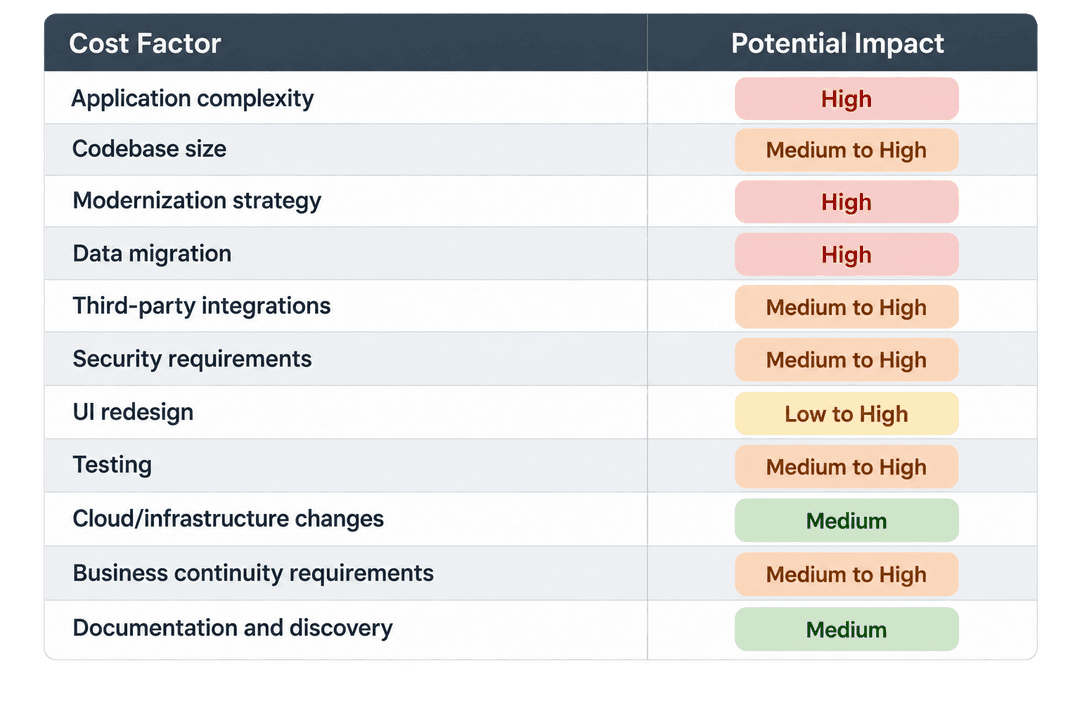
These factors should be evaluated together rather than used as independent estimates.
Why Legacy Modernization Can Become Expensive
The development work itself is only one part of the total cost.
A modernization project can also require significant effort in discovery, documentation, testing, migration, infrastructure, security, and deployment.
For example, a business may initially think:
"We only need to rebuild the application using a modern framework."
But during discovery, the team may find:
- Undocumented business rules
- Old database structures
- Hard-coded integrations
- Unsupported dependencies
- Duplicate data
- Manual processes
- Hidden dependencies between modules
These discoveries can change the scope considerably.
That is why a proper technical assessment should happen before committing to a final modernization budget.
How to Reduce Modernization Costs
Reducing cost does not necessarily mean choosing the cheapest modernization strategy.
Instead, businesses can reduce unnecessary spending by improving the planning process.
Start With an Assessment
Understand the existing architecture, dependencies, technical debt, data, integrations, and business-critical functionality before development begins.
Prioritize High-Value Areas
Not every component needs to be modernized at the same time.
Start with areas that create the greatest technical or business impact.
Modernize Incrementally
A phased approach can allow businesses to modernize parts of the application while keeping existing operations running.
Automate Testing
Automated regression and integration tests can reduce repetitive manual testing and provide greater confidence during migration.
Document Existing Business Logic
Understanding how the existing system works before rebuilding it can prevent important functionality from being accidentally lost.
Plan Data Migration Early
Data problems discovered late in a project can cause significant delays. Migration planning should begin during the discovery phase.
Should You Rebuild or Modernize Gradually?
This is one of the most important decisions in a modernization project.
A complete rebuild may make sense when the existing architecture is extremely difficult to maintain and the business requires significant changes.
A gradual modernization approach may make more sense when the existing system still provides valuable functionality and cannot be replaced all at once.
The decision should consider:
- Business risk
- Application complexity
- Budget
- Timeline
- Technical debt
- Data dependencies
- Integration requirements
- Availability requirements
- Long-term business goals
There is no single modernization strategy that works for every legacy application.
A Practical Legacy Modernization Cost Planning Process
A structured process can make budgeting more predictable.
Step 1: Assess the Existing System
Analyze the architecture, codebase, database, infrastructure, dependencies, and integrations.
Step 2: Identify Business-Critical Components
Determine which modules and workflows are essential to daily operations.
Step 3: Define the Target Architecture
Decide what the modernized environment should look like and which technologies are appropriate.
Step 4: Choose a Modernization Strategy
Determine whether rehosting, refactoring, replatforming, rebuilding, replacing, or a combination of approaches is appropriate.
Step 5: Estimate Each Workstream
Create separate estimates for:
- Development
- Data migration
- Infrastructure
- Integrations
- Security
- Testing
- Deployment
- Training and documentation
Step 6: Plan the Migration
Define how the system will move from the existing environment to the modernized solution with minimal business disruption.
Step 7: Modernize in Phases
Break a large modernization project into manageable releases where possible.
Final Thoughts
Legacy software modernization is not simply a development project. It is a combination of technology, data, security, infrastructure, testing, and business planning.
The total cost depends heavily on what already exists and what the business needs to achieve.
A small application with limited dependencies may require a focused modernization effort, while a large enterprise platform can require extensive analysis, migration, integration, and testing.
The most effective starting point is therefore not a fixed price estimate.
It is a technical and business assessment of the existing system.
Once the current environment, modernization goals, risks, and priorities are understood, organizations can choose the appropriate modernization strategy and create a much more realistic budget.
The goal should not simply be to replace old technology. It should be to create a system that is easier to maintain, secure, scale, and evolve with the business.