

A year ago, if you wanted your AI assistant to answer questions using your company’s own data, Retrieval-Augmented Generation (RAG) was the default architecture. Today, teams are running into its limits and moving toward something more capable: Agentic RAG.
This isn’t just a new buzzword or a rebrand. It represents a real shift in how AI systems solve problems. Businesses today expect AI to do much more than answer questions. They want it to analyze data, compare information, use APIs, automate workflows, generate reports, and make intelligent decisions. That requires more than a simple retrieve-and-answer approach.
What RAG Actually Does
RAG helps a language model answer questions using your company's own documents instead of relying only on the knowledge it learned during training.
The process is simple:
- User asks a question.
- The question is converted into an embedding.
- A vector database finds the most relevant document chunks.
- Those chunks are added to the model's context.
- The model generates an answer using that information.
That's it. One retrieval and one response.
This simple architecture made RAG the standard choice for:
- FAQ chatbots
- Internal knowledge assistants
- HR and policy search
- Product documentation
- Legal document search
It's fast, cost-effective, and easy to build.
However, RAG has one major limitation—it only performs a single retrieval. It doesn't understand whether a task actually requires multiple searches or several reasoning steps.
For example, ask a normal RAG system:
"Compare our three products, identify pricing gaps, and recommend the best solution for a healthcare client."
It may retrieve a few relevant documents and generate an answer, but it won't recognize that the request actually contains several independent tasks. It cannot naturally break the problem into smaller steps or decide that additional information is needed.
Another limitation is that RAG is reactive. It simply retrieves what appears most similar to the user's question. It doesn't ask itself whether the retrieved information is complete or whether another search could produce a better answer. As enterprise knowledge becomes distributed across documents, databases, APIs, CRMs, and cloud platforms, this limitation becomes much more obvious.
What Agentic RAG Adds
Agentic RAG uses the same retrieval system but adds an intelligent planning layer on top of it.
Instead of following one fixed path, it works in a loop.
The agent can:
- Understand the real goal
- Break the task into multiple steps
- Retrieve information for each step
- Decide whether more information is needed
- Call APIs or external tools
- Perform calculations
- Query databases
- Repeat the process until it has enough information
- Generate a final answer
The biggest difference isn't simply that it uses more tools.
The difference is that the AI decides what it should do next while solving the problem.
Instead of following a fixed "retrieve then answer" workflow, it plans, reasons, verifies information, and adapts as it works.
This makes Agentic RAG much better suited for enterprise applications where information lives in multiple systems. Rather than searching only documents, it can combine knowledge from vector databases, SQL databases, CRM systems, ERP software, cloud storage, APIs, spreadsheets, and even external services before producing an answer.
It behaves less like a search engine and more like a digital analyst.
Side-by-Side Comparison
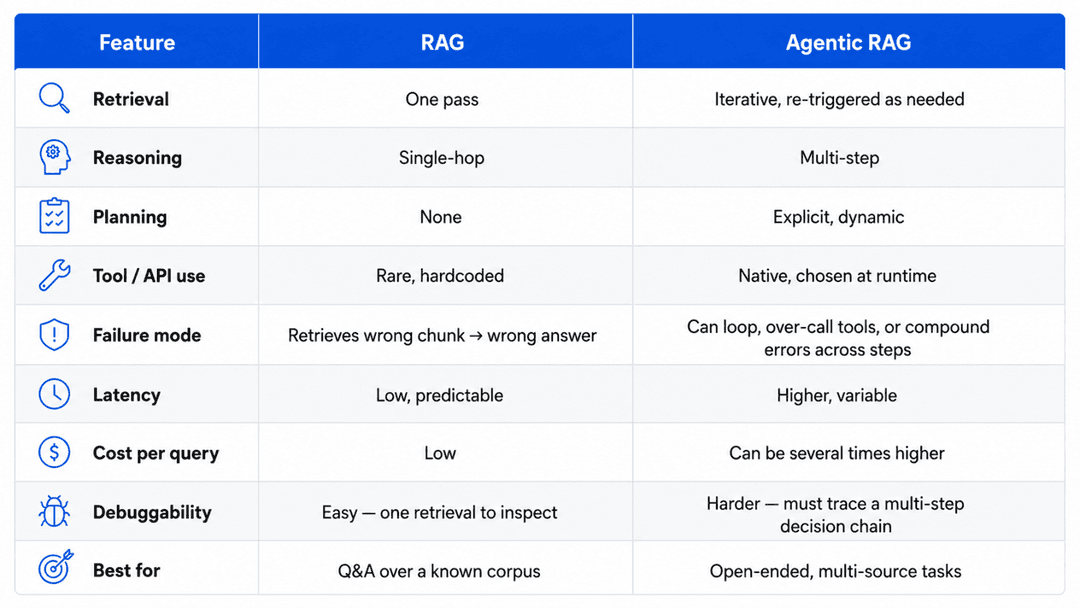
That “failure mode” and “cost” row matters more than most explainers admit — more on that below.
A Real Example
Suppose someone asks:
"Prepare a quarterly sales report and identify regions with declining performance."
Plain RAG
A normal RAG system retrieves previous sales reports and summarizes what's already written.
If everything needed already exists inside those documents, it performs well.
Agentic RAG
An Agentic RAG system can:
- Retrieve historical reports
- Query the live CRM
- Fetch recent sales data
- Calculate quarter-over-quarter growth
- Identify declining regions
- Generate charts
- Write a complete business report
This isn't just answering a question anymore.
It's completing an entire analysis workflow.
Of course, this also introduces more possible failure points. An incorrect API response, a calculation error, or poor planning can affect the final result.
The Tradeoffs Most People Don't Talk About
Many articles present Agentic RAG as the next version of RAG.
That's not really true.
It's simply designed for a different category of problems.
Higher Cost
Every planning step usually means another LLM call.
Every API request adds more latency.
A query that once required one model call may now require five or ten.
For thousands of daily support requests, that cost adds up quickly.
Slower Responses
More planning means more processing.
Simple questions that RAG answers in seconds may take significantly longer using Agentic RAG.
Harder Debugging
If RAG gives a wrong answer, you usually inspect the retrieved documents.
If Agentic RAG fails, the issue could be:
- Poor planning
- Wrong API call
- Incorrect intermediate reasoning
- Missing data
- Bad final synthesis
Finding the actual problem becomes much harder.
Risk of Endless Loops
Without proper limits, an AI agent may continue searching, calling tools, or requesting more information even when it's unnecessary.
That's why production systems require:
- Maximum step limits
- Tool call budgets
- Timeouts
- Validation checkpoints
- Human approval where needed
More Difficult Evaluation
Traditional RAG is relatively easy to evaluate because you mainly measure retrieval quality and answer accuracy.
Agentic RAG requires evaluating:
- Planning quality
- Tool selection
- Intermediate reasoning
- Final answer
There isn't one simple metric anymore.
Another challenge is governance. When AI agents start interacting with business systems, security becomes much more important. Permissions, audit logs, access control, approval workflows, and monitoring are essential to ensure the agent operates safely and doesn't perform unintended actions.
This is where many real-world AI projects spend more effort than on prompt engineering itself.
At Optimity Logics, we've found that there is rarely a single architecture that works for every business. Some organizations only need a well-designed RAG system to search internal knowledge quickly and accurately. Others need Agentic RAG because their workflows involve multiple databases, APIs, business tools, and decision-making steps. Selecting the right architecture based on the actual business problem helps reduce unnecessary costs while delivering AI systems that are reliable, scalable, and easier to maintain in production.
When Should You Use Each?
Choose RAG when:
- Questions require only one search
- You need fast responses
- Cost is important
- You're building FAQs or documentation search
- The information comes from one knowledge base
Choose Agentic RAG when:
- Tasks require multiple reasoning steps
- Information comes from several sources
- Live APIs or databases must be queried
- Reports need calculations
- Workflows involve automation
- Accuracy is worth the additional cost
Many companies are now using a hybrid approach.
Instead of sending every request through an AI agent, they begin with traditional RAG. If the query is simple, RAG answers it immediately. If the system detects that the task requires planning, calculations, or multiple information sources, only then is it routed to an Agentic RAG pipeline. This approach provides the best balance between speed, cost, and capability.
The Real Takeaway
RAG solved one important problem: giving language models access to your company's knowledge instead of relying only on training data.
Agentic RAG solves a different problem.
It allows AI to think through a task, decide what information it needs, use external tools, and complete multi-step workflows.
Neither architecture is universally better.
The best choice depends on the problem you're solving.
If all you need is accurate document search, RAG remains one of the most efficient solutions available.
If your AI needs to research, reason, plan, interact with business systems, and automate real workflows, Agentic RAG becomes the better choice despite its additional cost and complexity.
The smartest AI systems aren't necessarily the ones with the most autonomy—they're the ones using the right architecture for the right job.