

Artificial Intelligence has quickly become a part of almost every business conversation. From startups to large enterprises, organizations are investing in AI to improve productivity, reduce manual work, and deliver better customer experiences.
The results have been impressive.
AI can:
- Write content
- Summarize meetings
- Analyze documents
- Generate code
- Answer customer questions
- Automate repetitive tasks
...all in just a few seconds.
There's no doubt these capabilities save time.
But after watching how businesses are adopting AI, I keep coming back to one question.
Are we solving the right problem?
Most companies don't struggle because writing an email takes too long or because creating a report requires too much effort.
Their biggest challenge is making the right decisions at the right time.
Every Business Already Has the Data
Every day, businesses generate an overwhelming amount of information.
- A sales team is tracking leads.
- Marketing teams are monitoring campaigns.
- Customer support is handling tickets.
- Finance is reviewing cash flow.
- Operations are managing inventory and ongoing projects.
Every department has its own dashboard, reports, and KPIs.
The information already exists.
The problem is that it's scattered across different systems, making it difficult for leaders to understand what actually needs attention.
Instead of making decisions, many business owners spend a significant part of their day searching for information.
By the time they identify an issue, the impact has already started to show.
- A customer has already left.
- A deal has already gone cold.
- Inventory is already running low.
- A project deadline has already slipped.
These aren't failures caused by a lack of data.
They're failures caused by delayed visibility.
The Next Evolution of AI
This is where I believe the next evolution of AI begins.
Today's AI is largely reactive.
It waits for a prompt before taking action.
You ask a question, upload a document, or request a summary, and it responds.
That model works well for individual tasks.
Businesses, however, don't operate one task at a time.
They operate through continuous decisions.
Imagine beginning your day with a single update from your AI.
Instead of opening multiple dashboards, you receive a clear summary of what deserves your attention first.
For example:
- Five high-value leads haven't received a follow-up.
- Customer complaints increased after the latest product release.
- Marketing spend increased, but conversions remained unchanged.
- A key product is expected to be out of stock next week.
- One delayed approval is blocking a major client project.
Notice what makes this different.
The AI wasn't asked to generate a report.
It understood what was happening across the business and highlighted the issues that could have the biggest impact.
That's a completely different role from a chatbot.
Rather than acting as another assistant waiting for instructions, AI starts behaving like someone who understands how the business operates.
Someone who:
- Connects information across departments.
- Identifies priorities before they become problems.
- Helps leaders focus on decisions instead of dashboards.
The AI Chief of Staff
That's the idea behind what I call an AI Chief of Staff.
Not another chatbot.
Not another analytics tool.
But an intelligent business partner that continuously:
- Monitors the organization
- Identifies risks
- Uncovers opportunities
- Helps leadership focus on what matters most
I believe this shift—from answering questions to proactively guiding decisions—could become the next major evolution of business AI.
And the companies that adopt it early may gain an advantage that goes far beyond productivity.
In the next part, we'll explore what an AI Chief of Staff would actually do, how it could work across different business functions, and why this concept has the potential to become one of the biggest AI opportunities of the coming years.
From AI Assistant to AI Chief of Staff
So, what would an AI Chief of Staff actually do?
The answer isn't replacing your existing software.
It's making your existing software work together.
Today, most businesses rely on multiple platforms to manage daily operations.
- A CRM stores customer information.
- An accounting system tracks finances.
- A marketing platform measures campaign performance.
- A project management tool keeps teams organized.
Each system performs its own job well.
The challenge is that very few of them understand what's happening across the entire business.
As a result, business leaders spend hours:
- Switching between dashboards
- Comparing reports
- Trying to connect the dots before making a decision
An AI Chief of Staff changes that.
Instead of waiting for instructions, it continuously analyzes information across different systems and turns it into meaningful business insights.
Rather than showing everything that's happening, it highlights what actually matters.
Imagine starting your day with updates like these:
- A high-value customer hasn't placed an order in over 60 days.
- Three proposals worth more than $50,000 are waiting for approval.
- Customer support requests related to the latest product update have increased by 22%.
- Inventory levels suggest your best-selling product could run out next week.
- One marketing campaign is generating traffic but almost no qualified leads.
These aren't just notifications.
They're business priorities.
The goal isn't to overwhelm leaders with more data.
It's to help them focus on the few decisions that can create the biggest impact.
Across Different Business Functions
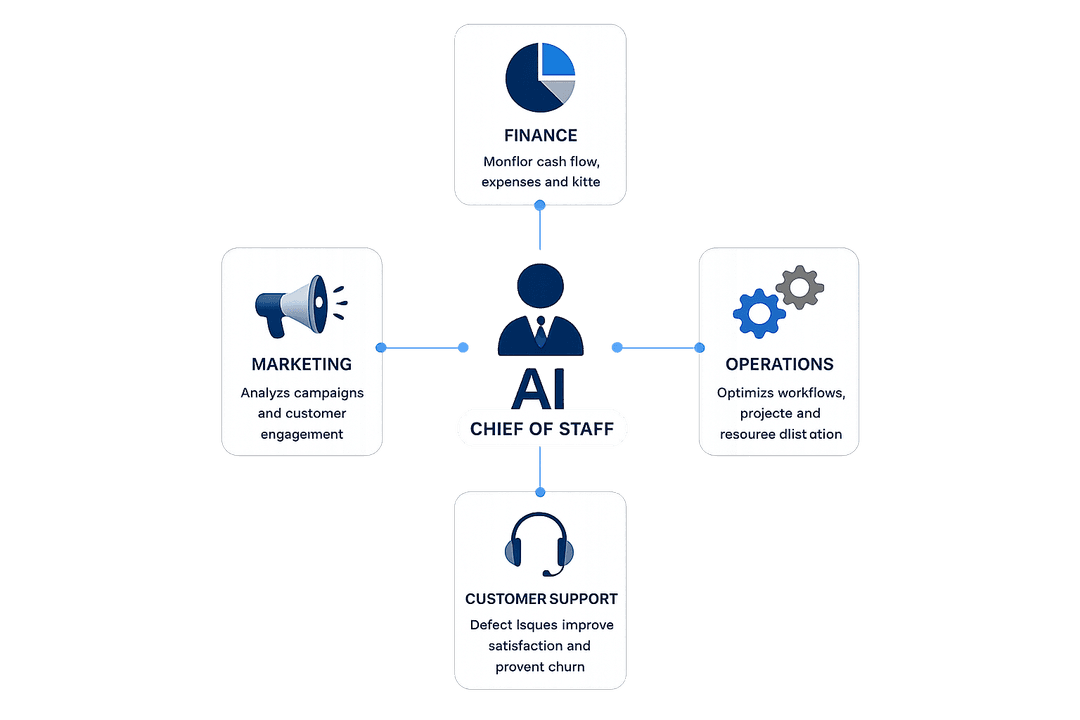
This idea becomes even more powerful when applied across different business functions.
Sales
AI could:
- Identify deals that are most likely to close.
- Detect opportunities at risk.
- Recommend which prospects deserve immediate attention.
Marketing
AI could:
- Compare campaign performance.
- Identify changes in customer behavior.
- Suggest where budgets should be increased or reduced.
Customer Support
AI could:
- Detect recurring issues before they become widespread.
- Identify customers at risk of leaving.
- Recommend proactive outreach instead of waiting for complaints.
Finance
AI could:
- Monitor cash flow trends.
- Identify unusual spending patterns.
- Highlight delayed payments.
- Forecast potential financial risks before they affect operations.
Operations
AI could:
- Track project delays.
- Inventory shortages.
- Supplier performance.
- Resource allocation.
- Help managers solve problems before they slow down the business.
Notice the Pattern
None of these examples focus on doing the work.
They focus on helping people make better decisions.
That's a much bigger opportunity.
Over the last few years, businesses have invested heavily in automation.
Automation saves time.
Decision intelligence creates competitive advantage.
The companies that succeed over the next decade won't necessarily be the ones with the most AI tools.
They'll be the ones using AI to:
- Recognize risks earlier.
- Prioritize work more effectively.
- Make smarter decisions with confidence.
The Opportunity
Of course, building an AI Chief of Staff won't be easy.
It will require:
- Secure access to business data
- Deep understanding of workflows
- Enough context to make recommendations that leaders can trust
But that's exactly why this opportunity is still wide open.
The next billion-dollar AI company may not build another chatbot.
It may build the first AI that truly understands how a business operates and helps leaders make better decisions every single day.
Final Thoughts
As AI continues to evolve, I believe the biggest winners won't simply ask:
"How can AI automate this task?"
They'll ask a much more valuable question:
"How can AI help us make better business decisions before problems become expensive?"
That shift in thinking could define the next generation of business software.
What do you think?
If your business had an AI Chief of Staff, what would be the first responsibility you'd give it?
Would you trust it to prioritize decisions, identify risks, or uncover new growth opportunities?